How AI Medical Intake Is Eliminating Registration Errors and Saving Clinics Time
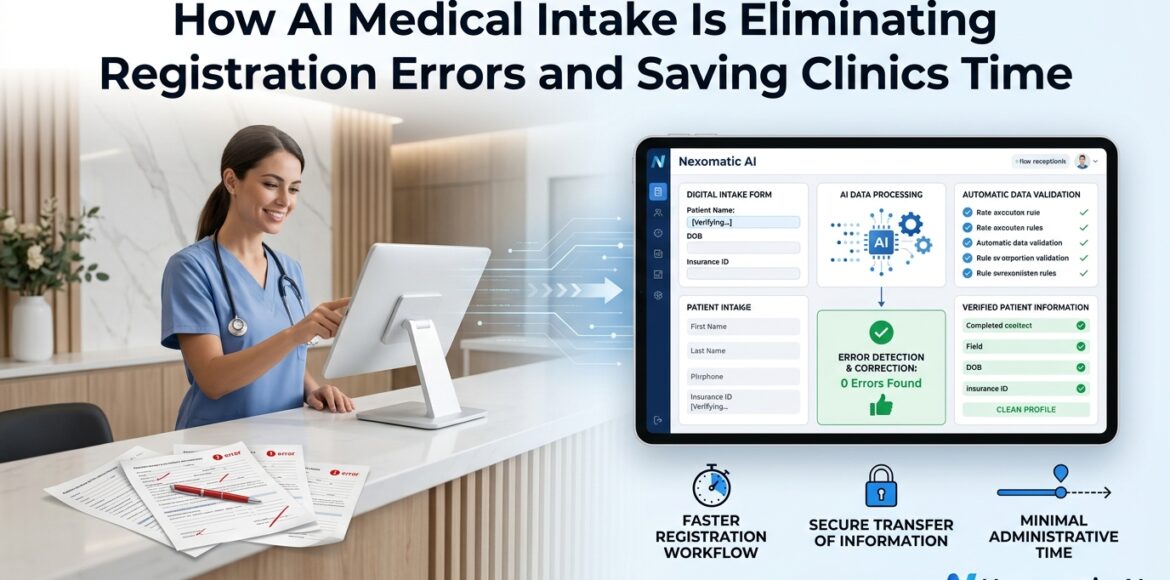
Every clinical visit begins the same way: a patient arrives, fills out paperwork, hands it to a front desk staff member, who manually keys the information into the practice management system or EHR — then discovers that the insurance number is illegible, the date of birth doesn’t match the file, or the coverage has lapsed since the last visit. The appointment is delayed. The billing cycle is compromised before a single clinical service is delivered. And the patient — who came in for care, not paperwork — starts their healthcare experience with frustration.
AI medical intake is ending this cycle. By digitizing and automating the full patient registration workflow — from pre-visit data collection and insurance verification through EHR data entry and eligibility confirmation — AI medical intake transforms the intake process from a staff-intensive, error-prone bottleneck into a fast, accurate, and patient-friendly operation that runs largely without human intervention.
This guide examines the specific costs of manual intake workflows, how AI medical intake works in practice, why healthcare organizations are making the transition, and how Nexomatic.ai is delivering AI medical intake results for practices across specialties and care settings.
The Real Cost of Manual Patient Intake Workflows
The inefficiency of manual patient intake is one of the most well-documented problems in healthcare operations — and one of the most persistently tolerated. Front desk staff spend significant portions of every shift re-entering data that patients have already provided on paper forms, resolving insurance eligibility questions that could have been answered before the patient arrived, and managing the appointment delays that cascade from intake bottlenecks during peak hours.
But the visible inefficiency is only part of the cost. The invisible costs are larger and more damaging to the financial health of the practice.
Registration Errors Drive Claim Denials
A miskeyed insurance ID, an incorrect date of birth, or a missing authorization number on the intake form creates a billing error that may not surface until a claim is denied — weeks after the service was delivered. At that point, correcting and resubmitting the claim requires significant staff time, introduces cash flow delay, and in some cases results in write-offs when the correction window has closed. AI medical intake eliminates the data entry step that generates these errors by capturing patient information directly in digital form and populating the EHR automatically without human transcription.
Insurance Verification Delays Affect Cash Flow and Scheduling
Real-time insurance verification — confirming that a patient’s coverage is active, understanding their copay and deductible status, and identifying any prior authorization requirements before the appointment — is one of the most time-consuming tasks in manual intake workflows. When verification is handled at the front desk on the day of service, it creates appointment delays, front desk backlogs, and the risk of rendering services that will not be reimbursed. AI medical intake moves this verification to the pre-visit window, completing eligibility checks automatically when the appointment is scheduled so that coverage status is confirmed before the patient ever arrives.
Staff Time Is Consumed by Repetitive Low-Value Tasks
Front desk staff in practices without AI medical intake spend between two and four hours per day on intake-related data entry — keying information from paper forms, scanning insurance cards, updating demographic records, and managing the exceptions that arise when information is missing or incorrect. This time cost is direct, measurable, and entirely eliminable through AI medical intake. The practices that implement AI medical intake consistently report that front desk staff can redirect that time to patient-facing interaction, appointment coordination, and the complex cases that genuinely require human judgment.
The practices most at risk from manual intake inefficiency are not those with the worst processes — they are high-volume practices where even a small per-patient error rate generates a large absolute number of billing problems and a significant administrative burden.
Patient Experience Suffers Before Clinical Care Begins
Long intake queues, clipboards full of repetitive questions, and front desk staff too busy to acknowledge waiting patients create a negative first impression that colors the patient’s entire experience of the visit. AI medical intake — delivered through digital pre-visit forms on a patient’s smartphone before they arrive — eliminates the waiting room paperwork experience entirely, allowing patients to walk in ready for their appointment and staff to greet them rather than process them.
What AI Medical Intake Actually Does
AI medical intake is not simply a digital version of a paper form. It is an end-to-end intelligent workflow that handles the collection, validation, verification, and routing of patient registration data without requiring manual intervention at each step. Understanding the full scope of what AI medical intake does helps healthcare organizations evaluate how comprehensively it can transform their administrative operations.
Pre-Visit Digital Data Collection
AI medical intake begins before the appointment. Patients receive a secure digital link — via SMS, email, or patient portal — that guides them through completing demographic information, medical history updates, insurance information, and consent forms on their own device at their own pace. The AI medical intake platform validates entries in real time: flagging incomplete fields, checking insurance ID formats, confirming date formats, and prompting patients to correct errors before submission rather than discovering them at the front desk.
Automated Insurance Eligibility Verification
Once insurance information is submitted, AI medical intake automatically queries payer eligibility systems to confirm active coverage, identify the patient’s benefit levels, and flag any prior authorization requirements for the scheduled service. This verification happens in the background, typically within seconds, and surfaces the results to both the scheduling team and the billing department before the appointment date. When coverage issues are identified, AI medical intake can automatically trigger patient outreach to resolve them in advance — eliminating the day-of coverage surprise that disrupts both the clinical schedule and the revenue cycle.
EHR Data Population
Patient-submitted data is mapped directly to the corresponding fields in the practice’s EHR system — no manual transcription, no re-keying, no human error introduced in the translation from paper to digital. AI medical intake platforms support integration with all major EHR systems, ensuring that the data captured during pre-registration flows seamlessly into the clinical record and is immediately available to the care team at the time of the appointment.
Intelligent Triage and Routing
Beyond data collection, AI medical intake can incorporate clinical triage logic — capturing symptom information, urgency indicators, and appointment reason details that help care coordinators prioritize the schedule and prepare the clinical team for each encounter. Patients with urgent symptom profiles can be flagged for same-day appointments or telehealth triage. High-risk medication combinations disclosed during intake can be surfaced to the prescribing provider before the visit begins.
Consent and Documentation Management
AI medical intake handles the collection and storage of all consent documentation — treatment consent, HIPAA acknowledgment, financial responsibility agreements, and specialty-specific authorization forms — through secure digital signature workflows. These documents are automatically associated with the patient’s record, time-stamped, and stored in a compliant document management environment that supports audit readiness without paper storage overhead.
Why Healthcare Organizations Are Replacing Paper Forms
The transition from paper-based intake to AI medical intake is accelerating across healthcare settings — from independent practices and specialty clinics to large health systems and urgent care networks. Several converging forces are driving this transition beyond the pure efficiency argument.
Revenue Cycle Performance Is Directly Tied to Intake Accuracy
Healthcare CFOs and revenue cycle directors increasingly understand that the revenue cycle begins at registration, not at billing. Every error introduced during manual intake — a wrong insurance ID, an inaccurate diagnosis code pre-populated from an outdated record, a missing authorization number — creates downstream billing friction that costs more to resolve than it would have cost to prevent. AI medical intake is the most direct investment a healthcare organization can make in front-end revenue cycle integrity, with ROI that typically materializes within the first quarter of deployment.
Patient Expectations Have Shifted Permanently
Patients who can check in for a flight, order groceries, and manage their banking entirely through their smartphone find paper intake forms not just inconvenient but jarring. Post-pandemic, the expectation of contactless, digital-first service has extended firmly into healthcare settings. Practices that offer AI medical intake — with pre-visit digital forms, automated appointment reminders, and instant confirmation — score measurably higher on patient satisfaction surveys than those that require patients to arrive early for paperwork.
Staffing Pressures Make Automation Essential
The healthcare administrative workforce is under sustained pressure. Front desk turnover rates are high, qualified administrative staff are difficult to recruit and retain, and the cost of training new employees on complex intake and billing workflows is significant. AI medical intake reduces the staffing dependency of the intake process — handling routine data collection, verification, and EHR entry automatically so that practices can maintain intake capacity even when administrative staffing is below ideal levels.
Regulatory Compliance Demands Digital Documentation
HIPAA, state-specific healthcare privacy regulations, and emerging digital health frameworks all create documentation requirements that are more reliably met through AI medical intake than through paper-based workflows. Digital consent records are automatically timestamped and retained. Access logs are maintained without manual effort. Data transmission is encrypted by default. The compliance infrastructure that AI medical intake provides protects practices from the audit exposure and penalty risk that paper-based documentation creates.
- Up to 80% reduction in intake time compared to paper-based workflows.
- Real-time insurance verification that identifies coverage issues before the appointment date.
- Direct EHR population that eliminates manual data entry and transcription errors.
- Digital consent management with automatic timestamping and audit-ready retention.
- Pre-visit triage logic that helps care teams prepare for each encounter in advance.
Healthcare organizations that implement AI medical intake are not just reducing administrative cost — they are building the front-end foundation that makes their entire revenue cycle more accurate, more compliant, and more resilient to staffing variation.
How Nexomatic.ai Powers AI Medical Intake for High-Volume Practices
Nexomatic.ai’s AI medical intake platform is built for the operational realities of high-volume healthcare environments where intake errors, insurance verification gaps, and front desk bottlenecks directly affect clinical capacity and revenue performance. The platform handles the full intake workflow — from pre-visit patient outreach through EHR data population and verification reporting — through integrated AI capabilities that operate continuously and surface exceptions for human attention rather than requiring staff to manage the routine.
What distinguishes Nexomatic.ai’s approach to AI medical intake is its domain-specific design. Generic patient intake tools apply one-size-fits-all forms and generic EHR integrations that require significant customization before they function correctly in a clinical environment. Nexomatic.ai’s AI medical intake system is built from the ground up for healthcare — with payer-specific eligibility query logic, specialty-appropriate intake form templates, EHR integration certified for the most widely used platforms, and compliance infrastructure that meets HIPAA requirements without configuration overhead.
Pre-Registration Outreach and Patient Guidance
Nexomatic.ai’s AI medical intake initiates patient outreach automatically when an appointment is scheduled — sending personalized digital intake invitations via the patient’s preferred channel, guiding them through form completion with real-time validation, and following up automatically with patients who have not completed their forms within the pre-visit window. This proactive outreach ensures intake completion rates that manual reminder workflows cannot achieve, reducing the proportion of patients who arrive on appointment day without completed registration.
Eligibility Verification at Scale
For high-volume practices processing dozens or hundreds of appointments per day, manual insurance verification is a resource constraint that limits scheduling capacity. Nexomatic.ai’s AI medical intake handles eligibility verification at scale — querying payer systems automatically for every scheduled appointment, returning structured benefit information to the scheduling and billing teams, and flagging coverage exceptions that require pre-visit resolution. This verification infrastructure ensures that every appointment begins with confirmed coverage rather than the assumption of it.
EHR Integration and Data Integrity
Patient data collected through Nexomatic.ai’s AI medical intake platform is mapped directly to EHR fields using certified integration workflows that maintain data integrity and minimize the mapping errors that generic intake tools introduce. The system supports bidirectional data flow — pulling existing patient records to pre-populate returning patient forms and pushing updated information back to the EHR after each intake cycle — ensuring that records are current without requiring staff to manage synchronization manually.
Healthcare organizations ready to eliminate intake bottlenecks and revenue cycle errors can explore Nexomatic.ai’s AI medical intake platform at Nexomatic.ai, learn about the dedicated medical intake solution at Nexomatic.ai Medical Intake, and discover the full healthcare automation suite at Nexomatic.ai Healthcare.
Building a Scalable Patient Experience with AI Medical Intake
For healthcare organizations thinking beyond immediate efficiency gains, AI medical intake is the foundation of a patient experience architecture that scales with practice growth without proportional increases in administrative overhead. The practices that extract the most strategic value from AI medical intake treat it not as a point solution for a paperwork problem but as the first component of a connected patient engagement system.
Connect Intake to the Full Care Journey
AI medical intake data — symptom information, medication lists, insurance status, consent documentation — is most valuable when it flows seamlessly into the clinical encounter and beyond. Practices that integrate AI medical intake with their clinical documentation, care pathway, and follow-up communication systems create a continuous data thread that supports better clinical decisions, more accurate billing, and more effective post-visit engagement. The intake is not the end of the workflow — it is the beginning of a data infrastructure that improves care quality at every subsequent touchpoint.
Use Intake Data to Optimize Scheduling
AI medical intake captures appointment reason and symptom information that can be used to optimize scheduling allocation — ensuring that visits requiring complex workup or extended consultation are booked in appropriate slots, that same-day urgencies are identified before they arrive at triage, and that provider schedules reflect the true complexity distribution of the day’s appointments. This scheduling intelligence, enabled by AI medical intake data, improves clinical flow and reduces the overrun that makes late-day appointments consistently unsatisfying for both patients and providers.
Build No-Show Prediction into the Intake Workflow
AI medical intake platforms can incorporate no-show risk modeling — analyzing appointment lead time, patient history, insurance verification status, and form completion behavior to identify appointments with elevated no-show probability. Practices that use this intelligence to trigger targeted confirmation outreach for high-risk appointments report measurable improvements in appointment fill rates and reductions in the empty appointment slots that represent direct revenue loss for the practice.
Scale Across Locations Without Scaling Staff
For healthcare organizations operating multiple clinic locations, AI medical intake provides a standardization and scalability advantage that manual intake cannot. A consistent AI medical intake workflow — with the same form templates, the same verification logic, the same EHR integration — can be deployed across all locations simultaneously, ensuring that the intake quality at location five is identical to location one without requiring site-specific training investments or dedicated intake coordinators at each site.
Frequently Asked Questions
How does AI medical intake handle patient data security?
Patient data security is a foundational requirement for any AI medical intake platform, and compliance with HIPAA is non-negotiable. Enterprise-grade AI medical intake systems encrypt all data in transit using TLS 1.2 or higher and at rest using AES-256 encryption. Access to patient records within the AI medical intake platform is governed by role-based access controls that limit data visibility to authorized users. All system interactions with patient data are logged in an immutable audit trail that supports compliance reporting and investigation of access anomalies. Business Associate Agreements are executed between the AI medical intake vendor and the covered entity before any protected health information is processed. Practices operating in multiple states should also verify that their AI medical intake platform meets any state-specific privacy requirements that are more stringent than the federal HIPAA baseline.
Can AI medical intake integrate with existing EHR systems?
EHR integration is a core capability of mature AI medical intake platforms. Leading AI medical intake solutions support certified integrations with the most widely used EHR systems in the US market — including Epic, Cerner, athenahealth, Meditech, eClinicalWorks, and others — through HL7 FHIR and proprietary API connections that ensure bidirectional data synchronization. When evaluating AI medical intake platforms, practices should verify that the integration with their specific EHR version has been certified and tested in production environments, not just documented as theoretically compatible. Custom EHR systems or legacy platforms may require additional integration development, and implementation timelines should account for this where applicable.
How does AI medical intake reduce claim denials?
AI medical intake addresses the three most common intake-related causes of claim denial: incorrect or missing patient demographic information, insurance eligibility failures, and missing prior authorization documentation. By collecting demographic data through validated digital forms rather than handwritten paper forms, AI medical intake eliminates the transcription errors that generate demographic-based denials. By performing real-time eligibility verification before the appointment, AI medical intake identifies coverage issues and authorization requirements before services are rendered — allowing practices to obtain necessary authorizations or adjust the appointment plan rather than rendering services that will not be reimbursed. Practices that implement AI medical intake consistently report measurable reductions in front-end denial rates within the first billing cycle following deployment.
What types of practices benefit most from AI medical intake?
AI medical intake delivers the highest impact in practices with high appointment volume, complex insurance populations, and significant front desk administrative burden. Specialty practices — orthopedics, dermatology, cardiology, behavioral health, physical therapy — that process large numbers of new patients with diverse insurance profiles benefit particularly from the automated verification and EHR population capabilities of AI medical intake. Multi-location practices benefit from the standardization and scalability that AI medical intake enables across sites. Urgent care and primary care practices with high walk-in volume benefit from the pre-registration outreach capabilities that reduce day-of intake burden. Telehealth-heavy practices benefit from AI medical intake’s ability to complete registration entirely digitally before the virtual visit begins, eliminating the technical friction and time loss that manual intake creates in virtual care settings.
AI medical intake is one of the highest-leverage operational investments available to healthcare organizations in 2026. The combination of front-end revenue cycle protection, patient experience improvement, administrative efficiency, and compliance automation delivers measurable returns across every dimension that healthcare operations leaders are accountable for — from claim denial rates and days in accounts receivable to patient satisfaction scores and staff productivity.
The practices that implement AI medical intake today are building the administrative infrastructure that allows them to grow patient volume, expand to new locations, and improve care quality without the staffing overhead that manual intake workflows demand. For healthcare organizations serious about operational excellence, AI medical intake is not an optional upgrade — it is the foundation.
Explore Nexomatic.ai’s AI medical intake solution and discover how it fits your practice at Nexomatic.ai Medical Intake. For the full healthcare automation suite, visit Nexomatic.ai Healthcare, or discover the complete platform at Nexomatic.ai.