AI Quality Assurance: How Intelligent Automation Is Eliminating Defects Before They Reach Customers
Quality is not a department — it is a competitive position. Businesses that consistently deliver products and services free from defects, errors, and inconsistencies build the customer trust that drives retention, referrals, and premium pricing. Those that allow quality failures to reach customers pay compounding costs: returns, rework, support burden, reputational damage, and the erosion of the customer relationships that took significant investment to build.
AI quality assurance is transforming how organizations protect that competitive position. By applying computer vision, machine learning, and intelligent process monitoring to quality control workflows, AI quality assurance catches defects, data errors, process deviations, and compliance failures at a speed and scale that manual quality control cannot approach — and at a point in the workflow where intervention is far less expensive than post-delivery correction.
This guide examines why manual quality control is increasingly inadequate, how AI quality assurance works across different operational contexts, and how Nexomatic.ai is helping organizations build quality operations that protect their reputation and their bottom line.
Why Manual Quality Control Is No Longer Sufficient
For decades, quality control meant human inspectors reviewing samples, checking checklists, and relying on experienced judgment to identify defects or process deviations. This approach worked — imperfectly — when production volumes were lower, product complexity was manageable, and customer tolerance for quality variation was higher. In 2026, none of those conditions hold.
Volume Has Outpaced Human Inspection Capacity
Modern production environments — whether manufacturing facilities, software development pipelines, data processing operations, or customer service organizations — generate quality-relevant events at a volume and velocity that human inspection cannot cover. AI quality assurance addresses this coverage gap by monitoring every unit, every transaction, and every process step rather than relying on sampling that leaves a significant proportion of output unexamined.
Sampling Introduces Systematic Risk
Statistical sampling — the foundation of traditional quality control — accepts that some proportion of defects will escape detection. For low-stakes products, this acceptance is tolerable. For high-stakes applications — medical devices, financial transactions, critical infrastructure software, food processing — the consequences of missed defects are severe enough that statistical acceptance is not an acceptable risk posture. AI quality assurance eliminates the sampling trade-off by enabling 100 percent inspection at the speed of production.
Complex Products Require Consistent Expert Judgment
Manual quality inspection quality degrades with inspector fatigue, shift changes, and the inherent variability of human attention. An inspector who accurately detects 97 percent of defects in the first hour of a shift may detect only 85 percent in the final hour. AI quality assurance applies the same analytical standard to every item inspected — no fatigue, no attention drift, no variability across shifts. That consistency is one of the most valuable contributions AI quality assurance makes to manufacturing and operational quality programs.
The organizations most at risk from inadequate quality control are not those with the worst products — they are those with sufficient volume that manual inspection cannot maintain the coverage their quality standards require.
How AI Quality Assurance Works in Practice
AI quality assurance is not a single technology — it is a family of AI capabilities applied to quality control problems across different operational contexts. Understanding which AI quality assurance capabilities apply to which problems helps organizations evaluate where to deploy the technology first.
Computer Vision for Visual Inspection
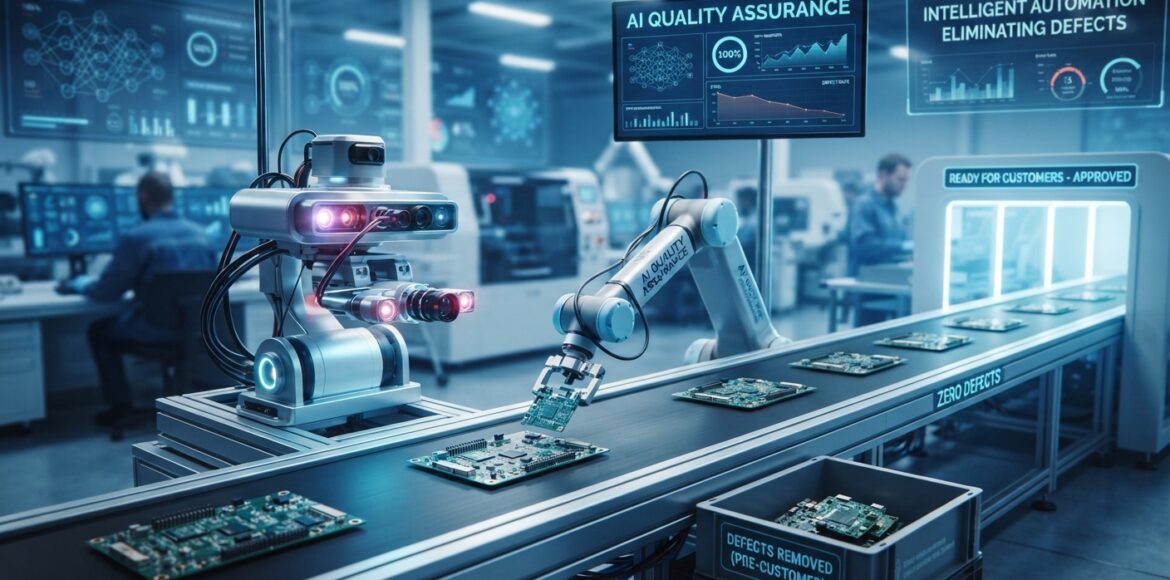
The most widely deployed form of AI quality assurance in manufacturing and production environments uses computer vision — AI systems trained to analyze images or video streams and identify visual defects, dimensional non-conformance, assembly errors, or labeling mistakes. Computer vision-based AI quality assurance systems inspect products at camera capture speed, detecting surface defects, missing components, and dimensional variations that human inspectors would miss at the same throughput rate.
Process Monitoring and Statistical Process Control
AI quality assurance extends beyond product inspection to monitor the production process itself — analyzing sensor data, equipment telemetry, environmental conditions, and process parameters in real time to detect deviations that indicate emerging quality risk before defective products are produced. This predictive dimension of AI quality assurance is particularly valuable because it shifts quality intervention from detection to prevention — stopping defects before they occur rather than catching them after.
Data Quality and Transaction Validation
In financial services, healthcare, logistics, and other data-intensive industries, AI quality assurance applies to data accuracy rather than physical products. AI quality assurance systems monitor data entry, transaction processing, and record management workflows to identify errors, inconsistencies, missing values, and anomalies that indicate data quality failures. The consequences of data quality failures in these industries — incorrect payments, inaccurate patient records, compliance violations — make AI quality assurance a critical operational control.
Customer Interaction Quality Monitoring
In service businesses, AI quality assurance monitors customer interactions — call recordings, chat transcripts, email communications — against defined quality standards, compliance requirements, and brand guidelines. This form of AI quality assurance identifies script deviations, compliance violations, tone misalignments, and service quality failures that supervisors cannot catch through manual spot-checking of a small sample of interactions.
How Nexomatic.ai Delivers AI Quality Assurance
Nexomatic.ai’s AI quality assurance solution addresses quality control challenges across multiple operational contexts — from manufacturing and production to data processing and customer service. The platform applies AI quality assurance capabilities that go beyond defect detection to encompass process monitoring, compliance validation, and continuous improvement intelligence.
- Real-time visual defect detection using computer vision trained on client-specific defect categories and product specifications.
- Process deviation monitoring that identifies quality risk signals in production data before defective output is generated.
- Data quality validation that monitors transaction and record accuracy across financial, healthcare, and logistics workflows.
- Customer interaction quality monitoring that evaluates service interactions against compliance requirements and quality standards.
- Defect trend analytics that surface systemic quality issues requiring process or specification adjustment.
- Integration with ERP, MES, and quality management systems that allows AI quality assurance findings to feed directly into corrective action workflows.
Learn how Nexomatic.ai’s AI quality assurance platform can protect your operational quality at Nexomatic.ai, and explore the dedicated quality assurance solution at Nexomatic.ai Quality Assurance.
Building a Culture of Quality with AI Quality Assurance
AI quality assurance technology is most effective when it is embedded in an organizational culture that treats quality as a strategic priority rather than a compliance obligation. Building that culture requires leadership commitment, cross-functional collaboration, and a measurement framework that connects quality performance to business outcomes.
Define Quality Standards with Precision
AI quality assurance systems are only as effective as the quality standards they enforce. Before deploying AI quality assurance technology, organizations must define precisely what constitutes acceptable and unacceptable output — with specificity sufficient to train AI models and configure detection thresholds. Vague quality standards produce inconsistent AI quality assurance performance; precisely defined standards enable the system to make reliable, consistent determinations at production speed.
Integrate Quality Data into Operations Decision-Making
The full value of AI quality assurance is realized when quality data is integrated into operational decision-making — not siloed in a quality management system that operations leaders never access. When production supervisors can see real-time defect rates by line, shift, and product type, they can make immediate adjustments. When supply chain leaders can see supplier quality performance trends, they can make better sourcing decisions. AI quality assurance transforms quality from a retrospective audit function into a live operational intelligence capability.
Use AI Quality Assurance to Enable Continuous Improvement
The defect detection data generated by AI quality assurance is one of the most valuable inputs to a continuous improvement program. Systematic analysis of defect patterns — by location, by production condition, by input material batch, by time of day — surfaces the root causes of quality failures that sporadic manual inspection would never reveal. Organizations that use AI quality assurance data to drive continuous improvement programs report defect rate reductions that compound over time, building a quality capability that becomes a genuine competitive differentiator.
Frequently Asked Questions
How does AI quality assurance handle product variants and customization?
Modern AI quality assurance platforms support multi-variant inspection — meaning the system can apply different quality standards and acceptance criteria to different product configurations, SKUs, or customer specifications within the same production run. The AI quality assurance model is trained on the full range of acceptable variants and adjusts its evaluation criteria automatically based on the product being inspected, eliminating the need to retrain the system for each new variant or reconfigure inspection parameters manually.
What happens when AI quality assurance identifies a defect?
The response workflow for AI quality assurance detections is configurable based on defect type and severity. Minor cosmetic defects may trigger a flag in the quality management system for batch review. Functional defects may trigger immediate removal from the production line and automatic generation of a non-conformance report. Critical safety defects may trigger a line stop and escalation to quality management personnel. The escalation logic is defined during AI quality assurance implementation based on the organization’s quality management policies and the consequences associated with different defect categories.
Can AI quality assurance be applied to software development and testing?
Yes — AI quality assurance is increasingly applied to software quality control, including automated test generation, code quality analysis, regression testing orchestration, and production defect detection. AI quality assurance in software development contexts analyzes code changes to predict which areas of the application are most likely to be affected, generates test cases that provide comprehensive coverage of the change, and monitors production performance metrics to detect quality degradation after deployment. This application of AI quality assurance is particularly valuable for organizations with high release velocity where manual testing cannot keep pace with development output.
How long does it take to implement AI quality assurance?
Implementation timelines for AI quality assurance vary by application complexity and integration requirements. For visual inspection applications with clearly defined defect categories and adequate training image libraries, initial deployment typically takes four to eight weeks. Data quality monitoring implementations that integrate with existing transaction systems are often deployable within two to four weeks. More complex deployments that require custom model training on proprietary defect types, integration with multiple production systems, and extensive validation against quality management standards may take three to six months from project initiation to full production operation.
AI quality assurance is the infrastructure that allows businesses to compete on quality without making quality control the limiting factor in their operational capacity. By monitoring 100 percent of output at production speed, detecting defects before they reach customers, and generating the data that drives continuous improvement, AI quality assurance enables organizations to build the quality reputation that is increasingly the most durable competitive advantage in any market.
Discover how Nexomatic.ai’s AI quality assurance solution can protect your operations and your reputation at Nexomatic.ai, and explore the full quality assurance platform at Nexomatic.ai Quality Assurance.