How AI Supply Chain Automation Is Ending Delays, Waste, and Manual Errors
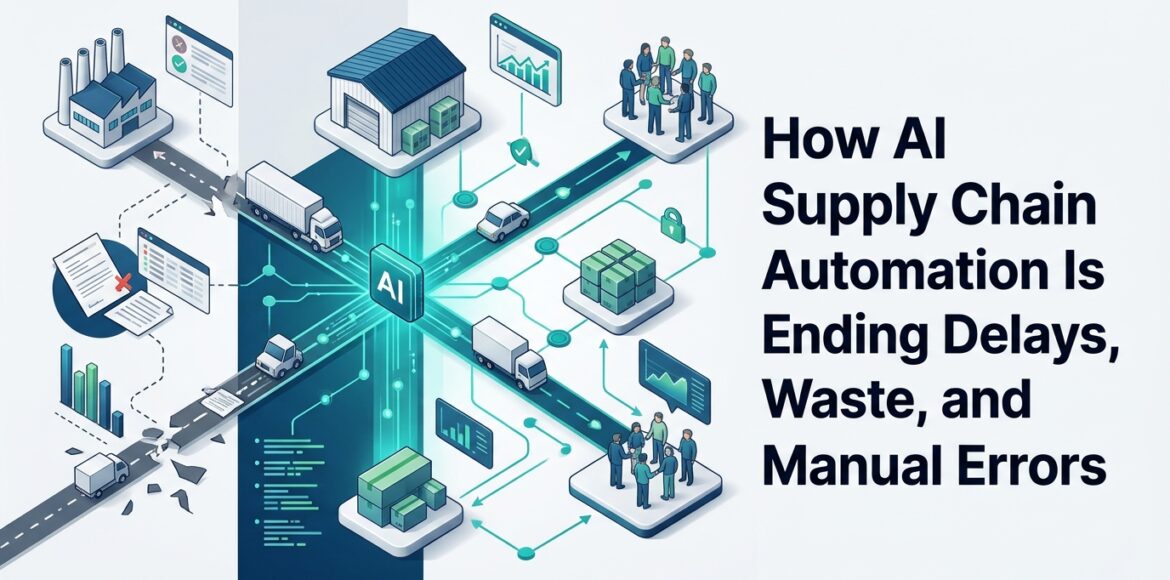
Supply chains have never been more complex — or more fragile. Global disruptions, fluctuating demand, rising fuel costs, and the persistent challenge of coordinating dozens of vendors across time zones have pushed logistics teams to their limits. The good news: AI supply chain automation is transforming how organizations manage procurement, inventory, routing, and fulfillment — replacing slow, error-prone manual processes with intelligent systems that act in real time.
This article explores how Nexomatic.ai deploys AI supply chain automation to help logistics leaders, operations managers, and procurement teams eliminate waste, reduce delays, and gain visibility across every node of their network.
The Real Cost of Running a Supply Chain Without AI
Manual supply chain management carries a hidden but substantial price tag. Procurement teams spend hours cross-referencing spreadsheets. Warehouse managers rely on gut feel for inventory decisions. Dispatchers manually assign routes without access to real-time traffic data. The result: overstocked warehouses, missed delivery windows, and ballooning operational costs.
Where Manual Processes Break Down
The failure points are well-documented. Demand forecasting errors can lead to 15–30% excess inventory or costly stock-outs. Manual routing wastes fuel and driver hours. Supplier onboarding through email chains introduces delays and compliance gaps. Each of these failures represents a direct hit to margin.
- Inventory inaccuracy rates of 20–30% in manual warehouse environments
- Up to 40% of procurement time consumed by repetitive data entry tasks
- Supply chain disruptions costing businesses an average of 6–10% of annual revenue
- Late shipments damaging customer trust and triggering penalty clauses
“AI supply chain automation doesn’t just speed up existing processes — it fundamentally changes what’s possible when your data works for you instead of against you.”
The companies moving fastest in 2026 are those that have replaced reactive, manual supply chain management with proactive, AI-driven systems that anticipate problems before they materialize.
What AI Supply Chain Automation Actually Looks Like in Practice
AI supply chain automation is not a single tool — it is a coordinated layer of intelligent agents, predictive models, and automated workflows that span procurement, warehousing, logistics, and supplier management. Here is what it looks like when implemented correctly.
Demand Forecasting and Inventory Optimization
AI systems ingest historical sales data, seasonal patterns, market signals, and external factors like weather and geopolitical events to generate accurate demand forecasts. These forecasts trigger automatic reorder points, adjust safety stock levels, and flag slow-moving inventory for liquidation — all without a human manually pulling reports.
The result: organizations using AI-driven demand forecasting report 20–30% reductions in inventory carrying costs and significantly fewer stock-out events.
Route Optimization and Last-Mile Delivery
AI supply chain automation systems analyze real-time traffic, vehicle capacity, delivery windows, and fuel costs to generate optimal routes dynamically. Unlike static routing tools, these systems recalculate routes mid-journey as conditions change, ensuring drivers always take the most efficient path.
- Fuel savings of 10–15% through optimized load planning and routing
- On-time delivery rates improving by 20–25% in AI-optimized fleets
- Reduced carbon emissions as a byproduct of fewer empty miles driven
Automated Supplier Communication and Procurement
Rather than email chains and manual purchase orders, AI agents handle supplier outreach, order placement, and status tracking autonomously. When a reorder threshold is hit, the system generates and sends a PO, confirms receipt, and tracks the shipment — escalating to a human only when an exception occurs.
“When AI handles supplier coordination end-to-end, procurement teams shift from inbox management to strategic sourcing — and that is where the real value gets created.”
Why AI Supply Chain Automation Is No Longer Optional
The competitive landscape has shifted. Organizations that have adopted AI supply chain automation are operating with fundamentally different cost structures and service levels than those still relying on manual processes. The gap is widening every year.
The Competitive Pressure Is Real
E-commerce giants and large 3PLs have spent years building AI-native supply chain operations. Their cost-per-unit, delivery speed, and inventory accuracy benchmarks have reset buyer expectations across B2B and B2C markets. Mid-market manufacturers, distributors, and retailers now face a choice: automate or fall behind.
Regulatory and ESG Requirements Are Increasing
Supply chain transparency is no longer optional. Regulations in the EU, UK, and increasingly in the US require companies to document supplier practices, track emissions, and demonstrate ethical sourcing. AI supply chain automation systems can generate these compliance reports automatically — flagging ESG risks across multi-tier supplier networks before they become legal liabilities.
- Automated ESG monitoring across Tier 1, 2, and 3 suppliers
- Real-time alerts when a supplier is flagged for financial instability or regulatory violation
- Automated audit trail generation for customs, compliance, and sustainability reporting
The Labor Shortage Is Not Going Away
Finding and retaining skilled warehouse workers, dispatchers, and procurement analysts is harder than ever. AI supply chain automation does not replace people — it allows existing teams to manage significantly more volume without adding headcount, and it reduces the cognitive load on the people who remain.
How Nexomatic.ai Powers AI Supply Chain Automation for Complex Operations
Nexomatic.ai builds domain-specific AI agents designed for the realities of supply chain management — not generic automation tools that require months of customization. Explore the full Nexomatic.ai logistics and supply chain automation capabilities to see how these solutions are deployed.
Multiagent Orchestration Across the Entire Chain
Where point solutions automate one step in isolation, Nexomatic.ai’s multiagent systems coordinate across procurement, warehouse management, dispatch, and customer notification simultaneously. When a supplier delay is detected, the system automatically: adjusts inventory forecasts, identifies alternative suppliers, reroutes pending shipments, and notifies affected customers — all without human intervention.
ERP and WMS Integration
AI supply chain automation only delivers value when it has access to the right data. Nexomatic.ai agents integrate directly with leading ERP systems (SAP, Oracle, Microsoft Dynamics) and warehouse management systems to pull real-time inventory levels, purchase orders, and shipment statuses. There is no manual export or data cleaning required.
- Real-time inventory visibility across multiple warehouse locations
- Automated three-way matching of POs, receipts, and invoices
- Predictive reorder triggers based on lead times and demand signals
- Supplier performance scorecards generated automatically each period
Custom AI Models for Your Industry’s Constraints
A food and beverage distributor managing cold chain compliance has different automation needs than an industrial parts manufacturer managing long lead-time components. Nexomatic.ai builds Domain-Specific Language Models (DSLMs) tuned to your industry’s regulations, SKU complexity, and data environment — not generic templates that require heavy reconfiguration.
“Nexomatic.ai’s AI supply chain automation is built for the specific regulations, data types, and supplier dynamics of your industry — not a one-size-fits-all tool that has to be forced to fit.”
The combination of multiagent orchestration, deep ERP integration, and domain-specific AI models means Nexomatic.ai clients see measurable results in weeks rather than months.
Measuring the ROI of AI Supply Chain Automation
Executives evaluating AI supply chain automation investments want to see the numbers. The business case for automation is compelling — and it compounds over time as AI models improve with more data.
Year-One Metrics That Matter
Organizations implementing AI supply chain automation consistently report measurable improvements across cost, speed, and accuracy within the first operating year:
- Inventory carrying costs reduced by 20–35% through better demand forecasting
- Order processing time cut by 50–70% through automated procurement workflows
- Shipment on-time rates improved by 15–25% through dynamic route optimization
- Supplier onboarding time reduced from weeks to days through automated document processing
- Compliance reporting time cut by 60–80% through automated ESG and customs documentation
The Compounding Effect
Unlike static software, AI supply chain automation gets better over time. As the system processes more orders, supplier interactions, and routing decisions, its predictions become more accurate. Organizations that implement AI supply chain automation in year one gain a compounding advantage over competitors who delay.
Beyond Cost Savings: Strategic Value
The ultimate ROI of AI supply chain automation is not just operational cost reduction — it is the strategic capacity it creates. When your procurement team is not chasing PO confirmations, they are negotiating better contracts. When your logistics managers are not manually rerouting delayed shipments, they are building carrier relationships. AI supply chain automation reclaims the time that leadership needs to focus on growth.
“The organizations winning in logistics today are the ones that turned their supply chain from a cost center into a competitive differentiator — and AI supply chain automation is the engine that made it possible.”
Frequently Asked Questions About AI Supply Chain Automation
How long does it take to implement AI supply chain automation?
Implementation timelines vary depending on the complexity of your existing systems and the scope of automation. Most Nexomatic.ai clients see initial workflows live within 4–8 weeks, with full multiagent orchestration across procurement, warehousing, and logistics complete within 3–4 months. Integration with ERP and WMS systems is typically the longest phase.
Does AI supply chain automation require replacing our existing ERP?
No. Nexomatic.ai’s AI agents are designed to integrate with and enhance your existing ERP, WMS, and TMS systems — not replace them. The AI layer sits on top of your current technology stack, pulling data in real time and automating actions through APIs. Most clients keep their existing systems and add the AI orchestration layer.
How does AI handle unexpected disruptions like port closures or supplier failures?
This is where AI supply chain automation delivers some of its greatest value. When a disruption signal is detected — through supplier monitoring, shipping APIs, or news feeds — the system automatically models the impact on your open orders, identifies alternative suppliers or routes, and proposes (or executes, depending on your configuration) a remediation plan. Human teams are alerted only when the disruption exceeds pre-defined thresholds.
Is AI supply chain automation suitable for mid-market companies, or only large enterprises?
AI supply chain automation is increasingly accessible for mid-market manufacturers, distributors, and retailers — not just Fortune 500 companies. Nexomatic.ai’s modular deployment approach means companies can start with high-impact, focused automation (such as demand forecasting or automated procurement) and expand from there, managing the investment in phases that match business growth.
Ready to Eliminate Supply Chain Complexity With AI?
AI supply chain automation is not a future technology — it is operational today, delivering measurable cost reductions, faster delivery windows, and greater resilience to the disruptions that derail manual operations. Nexomatic.ai builds the AI agents and multiagent systems that make this possible for companies across manufacturing, distribution, logistics, and retail.
The supply chains that will define competitive advantage in the next five years are being built now — by the organizations that chose to act before the cost of inaction became obvious. AI supply chain automation is how they are doing it.
Explore Nexomatic.ai’s logistics and supply chain automation solutions and discover what your operation looks like when every workflow runs on intelligence instead of instinct.