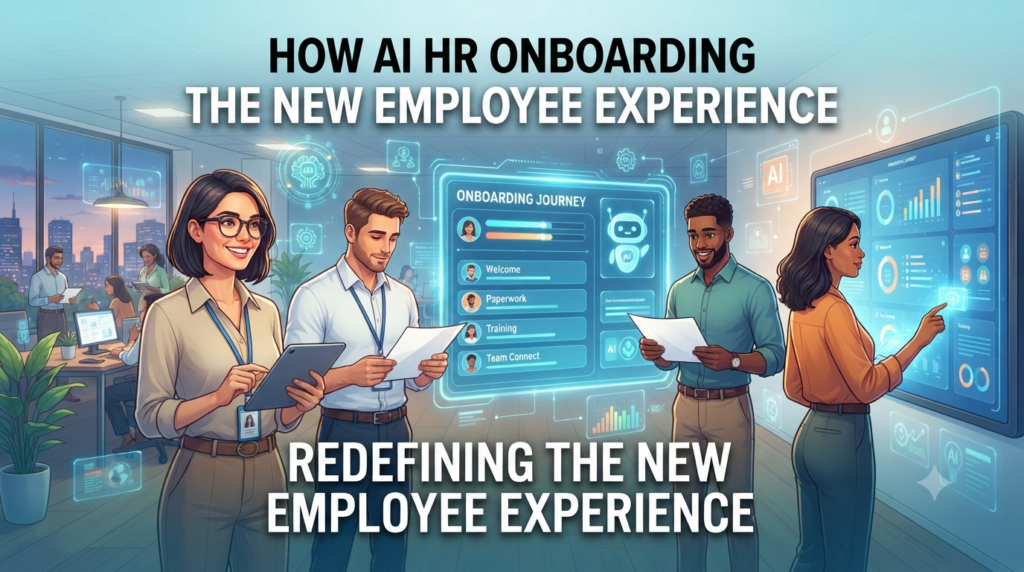
The first ninety days of a new employee’s tenure are the most consequential in their entire employment lifecycle. Research shows that employees who experience a structured, positive onboarding process are dramatically more likely to remain with the organization after one year, reach full productivity faster, and report higher levels of engagement and belonging. Yet for most organizations, employee onboarding remains a fragmented, manual, and inconsistent process that fails new hires precisely when they need the most support.
AI HR onboarding is transforming this critical window. By automating the coordination of tasks, communications, document workflows, system provisioning, and training delivery that constitute the onboarding experience, AI HR onboarding enables organizations to deliver a consistent, high-quality new hire experience at scale — without the administrative overhead that manual onboarding coordination demands.
This guide examines the specific failure modes of traditional onboarding, how AI HR onboarding addresses each of them, and how Nexomatic.ai is helping organizations across industries build onboarding operations that actually work.
The Hidden Cost of Poor Employee Onboarding
The cost of a failed onboarding is far higher than most organizations calculate. The direct cost of replacing an employee who leaves within the first year — recruiting, hiring, and training their replacement — typically ranges from 50 to 200 percent of that employee’s annual salary. Multiply that by the number of new hires who leave early due to a poor onboarding experience and the financial exposure is substantial.
But the indirect costs are equally significant. New employees who struggle through a disorganized onboarding arrive at their first week without the tools, access, or context they need to contribute. Their productivity ramp is longer. Their confidence is lower. Their first impression of the organization’s operational competence is negative. AI HR onboarding addresses each of these outcomes by ensuring that every logistical, informational, and social dimension of the onboarding experience is coordinated and delivered on time.
The Coordination Problem
Traditional onboarding requires HR to coordinate across IT for system access, finance for payroll setup, facilities for workspace preparation, legal for document completion, and the hiring manager for role-specific orientation — all simultaneously, for every new hire. AI HR onboarding automates this cross-department orchestration, triggering each team’s tasks automatically when offer acceptance is confirmed and tracking completion without requiring HR to chase each stakeholder manually.
The Consistency Problem
Manual onboarding quality varies dramatically depending on which HR coordinator manages the process, how busy the department is during the new hire’s start week, and how attentive the hiring manager is to their onboarding responsibilities. AI HR onboarding delivers a consistent experience regardless of these variables — every new hire goes through the same structured process, receives the same quality of communication, and has access to the same resources from day one.
AI HR onboarding is not about making onboarding faster for HR — it is about making onboarding better for the employee who will decide in the first ninety days whether this organization is worth their long-term commitment.
Core Capabilities of AI HR Onboarding Platforms
Understanding what AI HR onboarding technology actually does helps HR leaders evaluate platforms and set expectations for implementation outcomes. The most impactful AI HR onboarding capabilities address the specific failure modes that plague traditional processes.
Pre-Boarding Automation
The onboarding experience begins before the first day. AI HR onboarding platforms trigger welcome communications, document collection workflows, and system access requests immediately upon offer acceptance — so that new employees arrive on day one with their accounts provisioned, their paperwork completed, and their first-day agenda in hand. This pre-boarding automation eliminates the chaotic scramble that makes day one stressful for both new hires and HR teams.
Document and Compliance Workflow Management
AI HR onboarding automates the collection, routing, and storage of all employment documentation — offer letters, I-9 verification, tax forms, direct deposit authorization, benefits enrollment, policy acknowledgments, and role-specific compliance certifications. Digital signature workflows replace paper-based processes. Completion tracking ensures that nothing falls through the cracks. And compliance reporting is automatically maintained for audit purposes.
Training and Learning Path Delivery
AI HR onboarding platforms deliver structured learning content — company culture orientation, role-specific training, compliance modules, product knowledge resources — according to a personalized schedule that adapts to the new hire’s progress and role requirements. Rather than flooding new employees with information on day one, AI HR onboarding sequences content delivery appropriately over the first weeks and months.
Manager Enablement
Hiring managers are often the weakest link in the onboarding chain — not because of disinterest, but because they lack visibility into the onboarding progress of their new hire and receive no structured guidance on their own onboarding responsibilities. AI HR onboarding platforms provide managers with automated task reminders, check-in prompts, and progress dashboards that make their role in the onboarding process explicit and manageable.
Feedback and Early Warning Detection
AI HR onboarding platforms collect structured feedback from new employees at regular intervals through the first ninety days — identifying satisfaction signals, integration challenges, and early warning indicators of disengagement that allow HR and managers to intervene before a promising employee decides to leave. This feedback capability transforms AI HR onboarding from a process management tool into an employee experience intelligence system.
How Nexomatic.ai Powers AI HR Onboarding for Modern Organizations
Nexomatic.ai’s AI HR onboarding solution is designed for organizations that cannot afford to lose new employees to a poor first-impression experience. The platform orchestrates every dimension of the onboarding journey — from offer acceptance to full productivity — through a combination of automated workflows, intelligent communications, and cross-department coordination that operates without requiring constant HR intervention.
- Automated pre-boarding sequences that prepare new hires before their first day with welcome content, document requests, and system access provisioning.
- Cross-department task orchestration that coordinates IT, facilities, finance, and legal onboarding tasks automatically from a single platform.
- Personalized learning path delivery that sequences training content according to role, department, and individual progress.
- Manager enablement tools including automated check-in reminders, milestone prompts, and new hire progress visibility.
- Pulse survey automation that collects new hire feedback at day 7, day 30, and day 90 — surfacing early warning signals before they become retention problems.
- Compliance documentation management with digital signatures, completion tracking, and audit-ready reporting.
Learn how Nexomatic.ai’s AI HR onboarding platform can transform your new hire experience at Nexomatic.ai and explore the dedicated onboarding solution at Nexomatic.ai HR Onboarding.
Measuring the ROI of AI HR Onboarding
AI HR onboarding is an investment — and like any investment, it should be measured against clear outcomes. Organizations that implement AI HR onboarding with defined success metrics consistently demonstrate return that justifies and exceeds the platform cost.
Time to Productivity
The most direct measure of AI HR onboarding effectiveness is how quickly new employees reach the performance level expected of a fully ramped contributor. Organizations with structured AI HR onboarding programs report time-to-productivity improvements of 20 to 40 percent compared to unstructured manual onboarding — a difference that translates directly to revenue impact in sales roles and output impact in operational roles.
First-Year Retention
First-year voluntary turnover is the most costly signal of onboarding failure. Organizations that implement AI HR onboarding systematically report meaningful reductions in first-year attrition — because employees who feel supported, informed, and integrated in their first ninety days are significantly less likely to start looking elsewhere.
HR Administrative Efficiency
Beyond the employee experience metrics, AI HR onboarding delivers measurable efficiency gains for the HR function itself. Organizations report 50 to 70 percent reductions in the administrative time HR coordinators spend managing onboarding tasks, freeing them to focus on strategic talent development work that contributes more directly to organizational performance.
Frequently Asked Questions
How does AI HR onboarding handle different roles and departments?
Modern AI HR onboarding platforms support role-based and department-specific workflow configurations — meaning that the onboarding journey for a software engineer, a sales representative, and an operations manager can each follow a tailored path with role-appropriate training content, compliance requirements, and system access provisioning, all managed from the same platform. This configurability is what allows AI HR onboarding to deliver relevant, personalized experiences at scale without requiring HR to manually customize each individual’s onboarding process.
Can AI HR onboarding integrate with existing HRIS systems?
Integration with existing HRIS, ATS, and payroll systems is a core requirement for enterprise AI HR onboarding platforms. Leading solutions support native integrations with major HRIS platforms — ensuring that new hire data flows automatically from the ATS through the onboarding platform and into the HRIS without manual data entry. Organizations should verify integration compatibility with their specific systems during platform evaluation.
How does AI HR onboarding handle remote and hybrid employees?
Remote and hybrid onboarding presents specific challenges — equipment delivery coordination, virtual introductions, digital culture orientation, and asynchronous communication management — that AI HR onboarding platforms are specifically designed to address. Virtual welcome packages, scheduled video introductions, digital buddy programs, and remote-specific compliance workflows are all configurable within AI HR onboarding platforms, ensuring that the experience quality for remote hires is not significantly degraded compared to in-office onboarding.
What onboarding compliance risks does AI HR onboarding help manage?
AI HR onboarding reduces compliance risk across several dimensions: I-9 completion within the required three-day window, role-specific certification and training acknowledgment before equipment access is granted, benefits enrollment deadline management, and OSHA and harassment prevention training completion tracking. Automated reminder sequences ensure that time-sensitive compliance requirements are met without requiring HR to manually track each new hire’s completion status across a growing roster.
AI HR onboarding is one of the most impactful investments an organization can make in its talent strategy. The first ninety days determine whether a new hire becomes a long-term contributor or another avoidable turnover statistic — and AI HR onboarding is the infrastructure that makes that window consistently successful, regardless of hiring volume or team capacity.
Discover Nexomatic.ai’s AI HR onboarding solution at Nexomatic.ai and explore the dedicated platform at Nexomatic.ai HR Onboarding.