The insurance industry runs on two currencies: trust and speed. Policyholders who file claims need fast, fair resolutions. Carriers who process those claims need accurate, compliant workflows that minimize loss ratios and protect their regulatory standing. And insurtech companies competing against legacy carriers need operational efficiency that makes their pricing and service quality possible without proportional increases in headcount.
AI insurance automation is the technology that addresses all three imperatives simultaneously. By applying machine learning, natural language processing, and intelligent workflow orchestration to the full insurance operation — from policy issuance and underwriting through claims processing and compliance reporting — AI insurance automation enables carriers and insurtechs to process more business, with higher accuracy, at lower cost, while delivering the speed and transparency that modern policyholders demand.
This guide examines where AI insurance automation delivers the highest value, how the technology works in practice, and how Nexomatic.ai is helping insurance organizations build operations that are genuinely competitive in 2026.
The Operational Challenges That Make AI Insurance Automation Essential
Insurance is structurally one of the most data-intensive industries in the global economy. Every policy represents a contract built on thousands of data points. Every claim requires the collection, validation, and analysis of documentation from multiple sources. Every regulatory filing demands precise data aggregation and reporting against constantly evolving requirements. These operational characteristics make insurance one of the highest-value applications of AI insurance automation — because the volume, complexity, and accuracy requirements of the work are precisely the conditions where AI outperforms manual processing.
Claims Processing Velocity
Policyholder satisfaction with insurance providers correlates strongly with claims settlement speed. Yet traditional claims processing — manual document review, adjuster assignment, coverage validation, settlement calculation — is inherently slow, often taking days or weeks for straightforward claims that AI insurance automation can resolve in hours or minutes. This speed gap is a direct competitive disadvantage for carriers that have not adopted AI insurance automation.
Fraud Detection at Scale
Insurance fraud costs the industry tens of billions of dollars annually, and manual fraud detection — which relies on adjuster intuition and periodic audits — catches only a small fraction of fraudulent claims. AI insurance automation applies machine learning models trained on fraud patterns to every claim in real time, identifying suspicious signals that human reviewers would miss and flagging high-risk claims for investigation before payments are disbursed.
Compliance Complexity
Insurance is one of the most heavily regulated industries in the world, with requirements that vary by state, product line, and regulatory jurisdiction. Maintaining compliance manually requires dedicated regulatory affairs teams and constant monitoring of rule changes. AI insurance automation ingests regulatory updates automatically, validates processes against current requirements, and generates audit-ready compliance reports without the manual effort that traditional regulatory management demands.
AI insurance automation does not just make insurance operations faster — it makes them more accurate, more compliant, and more fraud-resistant simultaneously. That combination is what drives the ROI that justifies adoption.
Core Applications of AI Insurance Automation
AI insurance automation applies across the full insurance value chain — from customer acquisition and policy issuance through claims resolution and regulatory reporting. Understanding the specific applications helps insurance organizations prioritize their automation roadmap based on where the highest impact is achievable.
Intelligent Underwriting and Risk Assessment
Traditional underwriting requires analysts to manually review application data, credit reports, property information, and actuarial tables to assess risk and price policies. AI insurance automation performs this analysis in seconds — integrating data from internal systems, third-party data providers, IoT devices, and public records to generate risk assessments that are more comprehensive and more accurate than manual review. For low-risk applicants, AI insurance automation enables instant policy issuance that was previously impossible.
Claims Auto-Adjudication
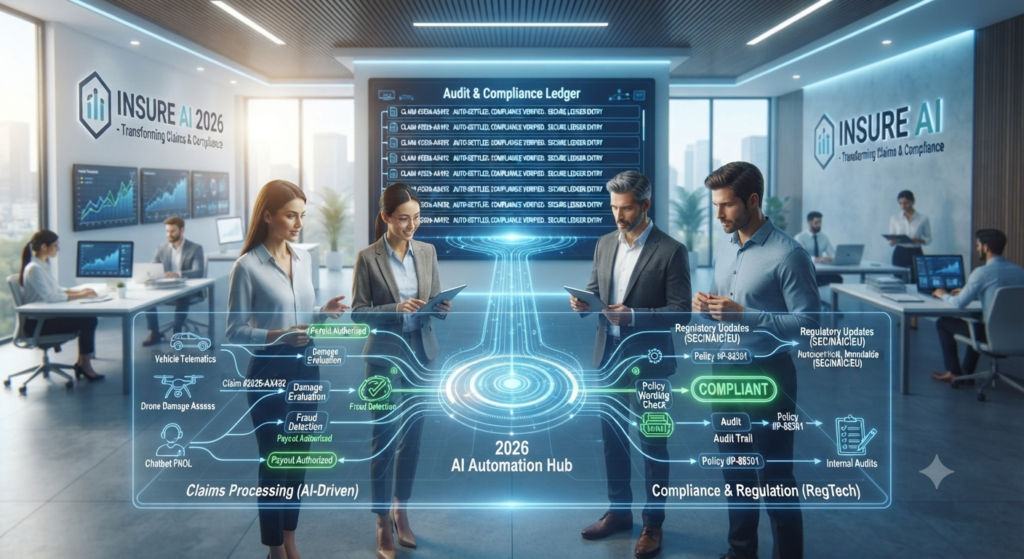
A significant proportion of insurance claims — particularly in auto, property, and health lines — follow predictable patterns that are fully resolvable through AI insurance automation without human adjuster involvement. These claims are submitted, validated against policy coverage, cross-referenced against fraud indicators, and settled automatically within hours. AI insurance automation reserves human adjuster time for the genuinely complex cases that require judgment — dramatically increasing adjuster productivity and reducing total claims processing cost.
Digital FNOL and Customer Self-Service
AI insurance automation enables policyholders to initiate claims through conversational AI interfaces that guide them through the First Notice of Loss process — capturing incident details, collecting supporting documentation, confirming coverage, and providing immediate acknowledgment with a clear next-steps timeline. This digital FNOL capability eliminates the friction and wait time of phone-based claims initiation while capturing better-quality initial documentation than traditional methods.
Policy Administration and Renewal Management
AI insurance automation handles the routine administrative tasks that constitute a significant proportion of insurance operations overhead — policy endorsement processing, renewal notice generation, cancellation management, and mid-term adjustment processing. By automating these workflows, AI insurance automation frees operations staff to focus on the customer relationship management and complex case handling that requires human engagement.
How Nexomatic.ai Delivers AI Insurance Automation
Nexomatic.ai’s AI insurance automation platform is built for carriers and insurtechs that need to compete on operational efficiency without sacrificing the accuracy and compliance that the regulatory environment demands. The platform addresses the full insurance operations workflow — underwriting, claims, customer service, and compliance — through integrated AI capabilities that work together rather than as isolated point solutions.
- Claims auto-adjudication that resolves standard claims within hours, reserving adjuster time for complex and suspicious cases.
- Real-time fraud detection that cross-references each claim against behavioral patterns, historical data, and third-party signals before payment authorization.
- Digital FNOL intake through conversational AI that guides policyholders through claim submission on any channel.
- Intelligent underwriting support that integrates multi-source data to accelerate risk assessment and enable instant policy issuance for qualifying applicants.
- Compliance automation that monitors regulatory changes, validates process adherence, and generates audit-ready reports automatically.
- Customer self-service through AI voice and chat that handles policy inquiries, ID card requests, coverage verification, and claim status updates 24/7.
Discover how Nexomatic.ai’s AI insurance automation platform can transform your operations at Nexomatic.ai, and explore the dedicated insurance solution at Nexomatic.ai Insurance & Insurtech.
Measuring the ROI of AI Insurance Automation
Insurance organizations evaluating AI insurance automation investments should assess ROI across three dimensions: operational cost reduction, revenue protection through fraud prevention, and customer experience improvement that drives retention and new business.
Claims Processing Cost Reduction
The cost per claim handled through AI insurance automation is significantly lower than the cost of manual adjudication — with reductions of 40 to 70 percent reported by organizations that have implemented comprehensive auto-adjudication workflows. For high-volume carriers processing hundreds of thousands of claims annually, this cost reduction is the most significant ROI driver from AI insurance automation.
Fraud Loss Recovery
AI insurance automation fraud detection recovers losses that manual review misses. Organizations that implement AI insurance automation report fraud detection rates three to five times higher than manual review — translating directly into reduced loss ratios and improved underwriting profitability.
Customer Retention Through Speed
Policyholder satisfaction correlates strongly with claims settlement speed, and AI insurance automation dramatically reduces settlement timelines. Carriers that implement AI insurance automation for claims processing report measurable improvements in Net Promoter Scores and policyholder retention rates — benefits that compound over time as retained policyholders represent significantly lower acquisition cost than replacement business.
Frequently Asked Questions
Which types of insurance claims are best suited for AI automation?
Straightforward, documentation-complete claims with clear coverage applicability are the highest-value targets for AI insurance automation. In auto insurance, minor collision claims with photos and police reports. In property insurance, weather damage claims with inspection data. In health insurance, routine procedure claims with complete clinical documentation. The common characteristic is predictability — claims that follow a well-defined pattern that AI insurance automation can validate and settle without human judgment. Complex liability claims, disputed coverage situations, and fraud investigations remain in the human adjuster workflow.
How does AI insurance automation handle the regulatory variation across states?
Enterprise AI insurance automation platforms maintain regulatory rule libraries that are updated continuously as state requirements change. These libraries govern the specific validation steps, documentation requirements, settlement timelines, and disclosure obligations that apply to each claim type in each jurisdiction. When a claim is processed, the AI insurance automation system applies the correct regulatory framework automatically based on the policy’s state of issuance and the claim type — ensuring compliance without requiring operations staff to manually track jurisdiction-specific requirements.
Can AI insurance automation integrate with existing core systems?
Core system integration is a fundamental requirement for enterprise AI insurance automation, and leading platforms support certified integrations with major insurance core systems including Guidewire, Duck Creek, Majesco, and custom policy administration systems. These integrations allow AI insurance automation to access policy data, claims history, and customer records in real time — enabling accurate validation and processing without data re-entry or manual synchronization.
How does AI insurance automation protect against new and emerging fraud schemes?
AI insurance automation fraud detection models are continuously updated as new fraud patterns emerge. This is a critical advantage over rule-based fraud detection systems, which only catch schemes that their rules are designed to detect and are easily circumvented by fraudsters who understand the rules. Machine learning models used in AI insurance automation identify statistical anomalies across large claim datasets — catching fraud schemes that are novel precisely because they deviate from established patterns, rather than only those that match known rules.
AI insurance automation is redefining what operational excellence looks like in the insurance industry. Carriers and insurtechs that adopt AI insurance automation are not just cutting costs — they are building the operational infrastructure that allows them to price more competitively, serve customers faster, detect fraud more effectively, and maintain compliance more reliably than organizations that continue to rely on manual processes.
Explore Nexomatic.ai’s AI insurance automation solutions at Nexomatic.ai, and discover the dedicated insurance platform at Nexomatic.ai Insurance & Insurtech.