Every business runs on email. Sales teams send prospecting sequences. Customer success teams send onboarding nudges. Finance teams chase overdue invoices. HR teams coordinate interview confirmations. Across every department, email is the connective tissue that holds business communication together — and for most organizations, managing that email volume is a significant drain on human time and attention.
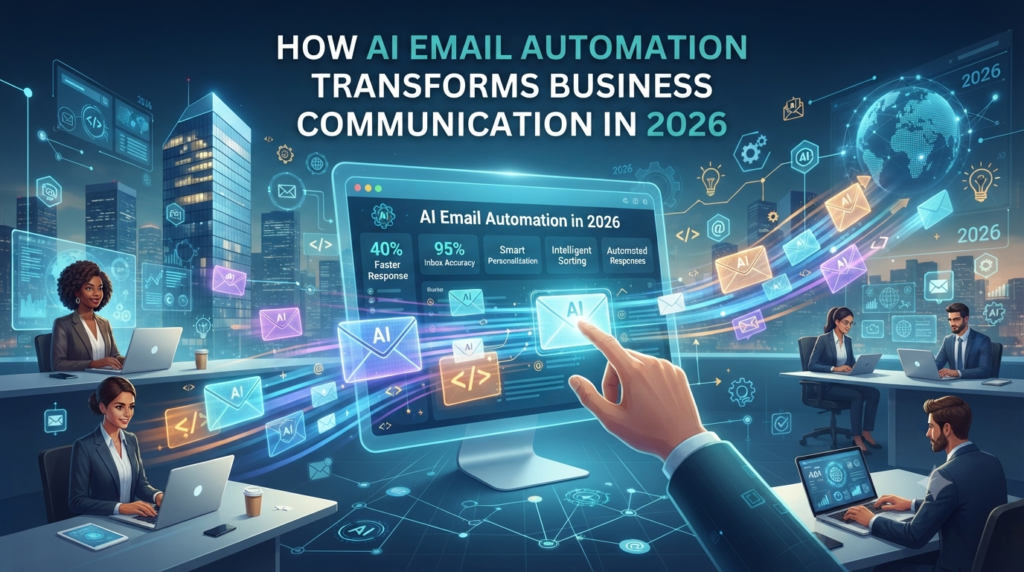
AI email automation is rewriting that reality. By applying machine learning, natural language processing, and behavioral triggers to email workflows, AI email automation enables businesses to send the right message to the right person at precisely the right moment — without a human writing, scheduling, or following up on each individual email.
This guide examines why AI email automation has become a strategic priority for growth-focused businesses, what capabilities separate top platforms from basic schedulers, and how Nexomatic.ai is delivering AI email automation results for organizations across industries.
Why Manual Email Management Is Costing Your Business
The scale of the problem is easy to underestimate. Research consistently shows that knowledge workers spend between two and three hours per day managing email — reading, writing, sorting, following up, and searching for information buried in threads. For a business with fifty employees, that is roughly five thousand hours of collective productivity lost to email management every single week.
Beyond raw time cost, manual email management introduces inconsistency that directly affects business outcomes. A sales rep who forgets a follow-up loses a deal. A customer success team that sends generic onboarding emails sees slower activation rates. A finance team chasing payments manually misses the behavioral window when a reminder would be most effective. AI email automation eliminates each of these failure modes by making the consistent, timely, personalized execution of email workflows automatic.
The Follow-Up Problem
Studies show that the majority of sales are closed after the fifth follow-up — yet most sales reps give up after two. AI email automation solves this persistence gap by executing follow-up sequences automatically, adjusting timing and messaging based on recipient behavior, and escalating to human attention only when a prospect signals genuine engagement that warrants a personalized touch.
The Personalization Gap
Generic emails perform poorly. Subject lines that reference the recipient’s name, company, or recent behavior dramatically outperform broadcast messaging on open rates, click rates, and conversion. AI email automation makes this personalization scalable — generating customized email content for thousands of recipients simultaneously, drawing on CRM data, behavioral triggers, and contextual signals to make each message feel individually crafted.
AI email automation does not replace the human voice in business communication — it ensures that voice reaches every person who needs to hear it, at the moment they are most likely to respond.
What Separates AI Email Automation from Basic Email Tools
Not every email tool that calls itself automated qualifies as true AI email automation. The distinction matters, because the gap in performance between rule-based schedulers and genuine AI email automation platforms is substantial.
Behavioral Triggering vs. Time-Based Scheduling
Basic email tools send emails on a schedule: day one, day three, day seven. AI email automation sends emails in response to behavior: when a prospect opens a previous email, visits a pricing page, downloads a resource, or goes silent after a previously active engagement pattern. Behavioral triggering produces dramatically higher engagement rates because the timing is contextually relevant rather than arbitrary.
Dynamic Content Generation
AI email automation platforms can generate email content dynamically based on recipient data — referencing the recipient’s industry, company size, recent activity, or stage in the customer lifecycle. This goes well beyond mail merge: the AI constructs messaging that addresses the specific context of each recipient rather than inserting a name into a fixed template.
Intent Recognition and Routing
When recipients reply to automated emails, AI email automation systems analyze the response to determine intent — positive interest, objection, out-of-office, unsubscribe request — and route accordingly. Positive replies can trigger immediate human agent notification. Objections can trigger specific counter-messaging sequences. This intelligence layer transforms AI email automation from a one-way broadcast system into a responsive communication workflow.
Deliverability Intelligence
AI email automation platforms monitor sender reputation, manage sending volume to avoid spam filter triggers, optimize send times based on historical open data for each individual recipient, and rotate sending domains or mailboxes as needed to maintain inbox placement. Deliverability intelligence is invisible when it works and catastrophic when it fails — making it one of the most important differentiators among AI email automation platforms.
AI Email Automation Across Business Functions
The use cases for AI email automation span every revenue-generating and customer-facing function in a modern business. Understanding where AI email automation delivers the highest impact helps organizations prioritize their implementation roadmap.
Sales and Pipeline Development
AI email automation enables sales teams to run multi-touch outbound sequences at scale without sacrificing the personalization that makes cold outreach effective. Prospect research data, company news, and intent signals can be incorporated into opening lines automatically. Follow-up sequences execute without manual reminders. And AI email automation surfaces the prospects showing the highest engagement for immediate human follow-up.
Customer Onboarding and Activation
The period immediately after a customer signs up is the highest-leverage window for driving product adoption and long-term retention. AI email automation delivers precisely timed onboarding sequences that guide new users through key activation steps, trigger check-in messages when engagement drops below expected thresholds, and escalate to human success managers when behavioral signals indicate a customer at risk of churning.
Revenue Recovery and Collections
Failed payment recovery is one of the highest-ROI applications of AI email automation in subscription businesses. Automated dunning sequences — triggered the moment a payment fails, with escalating urgency and varied messaging approaches over subsequent days — recover a significant proportion of revenue that would otherwise be lost without requiring collections staff to manage the process manually.
Renewal and Expansion
AI email automation drives renewal and upsell conversations by monitoring customer health signals and triggering targeted outreach at the optimal moment. Customers approaching contract renewal receive timely, relevant messaging. Customers who have reached usage thresholds that indicate readiness for an upgrade receive expansion offers. All of this happens automatically, driven by the behavioral data that AI email automation platforms monitor continuously.
How Nexomatic.ai Delivers AI Email Automation at Scale
Nexomatic.ai’s AI email automation platform is built for organizations that need more than a simple newsletter scheduler. Designed to handle the full complexity of multi-department, multi-audience email workflows, the platform combines behavioral intelligence, CRM integration, and dynamic content generation into a unified system that operates continuously without manual intervention.
- Behavioral trigger library covering the full customer lifecycle — from first touch through renewal and expansion.
- Native CRM integration that pulls real-time customer data into email personalization without manual data export.
- AI-generated subject lines and body copy that adapt to recipient segment, engagement history, and current lifecycle stage.
- Intent recognition that routes replies to the appropriate human team member or automated follow-up sequence.
- Deliverability monitoring and sender reputation management that protect inbox placement across high-volume sending.
- Analytics dashboards that surface the sequences, subject lines, and send times producing the highest engagement — enabling continuous optimization.
Businesses ready to transform their email workflows with AI email automation can explore the full platform at Nexomatic.ai and learn specifically about the email automation capabilities at Nexomatic.ai Email Automation.
Organizations that implement AI email automation report not just efficiency gains but revenue outcomes — more deals closed, faster customer activation, lower churn, and more consistent account expansion.
Implementing AI Email Automation: A Practical Roadmap
The difference between AI email automation that transforms a business and AI email automation that sits unused after initial deployment comes down to implementation quality. Organizations that follow a structured approach consistently outperform those that treat the platform as a set-it-and-forget-it tool.
Start with High-Volume, High-Frequency Workflows
The fastest ROI from AI email automation comes from automating the workflows that currently consume the most human time and have the most predictable structure. Sales follow-up sequences, payment reminder campaigns, and onboarding drip sequences are ideal starting points because they are well-understood, measurable, and immediately impactful.
Map the Full Trigger Logic Before Building
AI email automation sequences that feel natural to recipients are built on carefully considered trigger logic. Before building any sequence, map the full set of conditions that should start, pause, modify, or end the sequence — including what happens when a recipient replies, what happens when they don’t, and what human escalation criteria apply. This mapping work is the most important pre-build investment in an AI email automation project.
Test Subject Lines and Content Systematically
AI email automation platforms enable A/B testing at a scale that manual email management cannot match. From day one, run systematic tests on subject line approaches, email length, call-to-action placement, and send timing. The compounding performance improvement from systematic testing is one of the most significant advantages of AI email automation over manual email management.
Review and Refresh Quarterly
AI email automation sequences decay in performance over time as market conditions change, recipient expectations evolve, and the novelty of specific approaches fades. Schedule quarterly reviews of every active AI email automation sequence to assess performance metrics, identify declining engagement, and refresh content and trigger logic to maintain effectiveness.
Frequently Asked Questions
How is AI email automation different from a standard autoresponder?
A standard autoresponder sends a fixed sequence on a fixed schedule regardless of recipient behavior. AI email automation responds to behavior — opening emails, clicking links, visiting web pages, going silent, replying with specific intent signals — and adjusts timing, content, and escalation logic accordingly. The behavioral responsiveness of AI email automation is what produces dramatically higher engagement rates compared to static autoresponder sequences.
Can AI email automation handle replies from recipients?
Yes — this is one of the most important capabilities that distinguishes true AI email automation from basic scheduling tools. When recipients reply, AI email automation platforms analyze the response for intent: positive interest triggers human notification or a specific follow-up sequence; objections trigger counter-messaging; unsubscribe requests are honored automatically; out-of-office replies pause the sequence until the recipient returns. This two-way intelligence is what makes AI email automation a genuine communication system rather than a broadcast tool.
Is AI email automation compliant with GDPR and CAN-SPAM?
Reputable AI email automation platforms incorporate compliance requirements into the platform architecture — managing unsubscribe processing, maintaining suppression lists, honoring opt-out requests within the required timeframe, and providing the data access and deletion capabilities required by GDPR. Organizations should verify that their chosen AI email automation platform maintains current compliance documentation and provides the contractual commitments required for their operating jurisdiction.
How long does it take to see results from AI email automation?
Most organizations implementing AI email automation report measurable performance improvements within the first four to six weeks — particularly in follow-up conversion rates, response rates, and time-to-resolution for customer onboarding workflows. The compounding benefits of continuous A/B testing and behavioral optimization mean that AI email automation performance typically improves significantly over the first six months of deployment as the system learns from engagement data and sequence refinements are made.
AI email automation is one of the highest-leverage investments a growth-focused business can make in 2026. The combination of behavioral intelligence, personalization at scale, and continuous optimization delivers revenue outcomes that manual email management simply cannot match — at a fraction of the human time cost.
Explore Nexomatic.ai’s AI email automation platform at Nexomatic.ai and discover the full email automation solution at Nexomatic.ai Email Automation.